Stop looking at stocks.
Start understanding businesses.
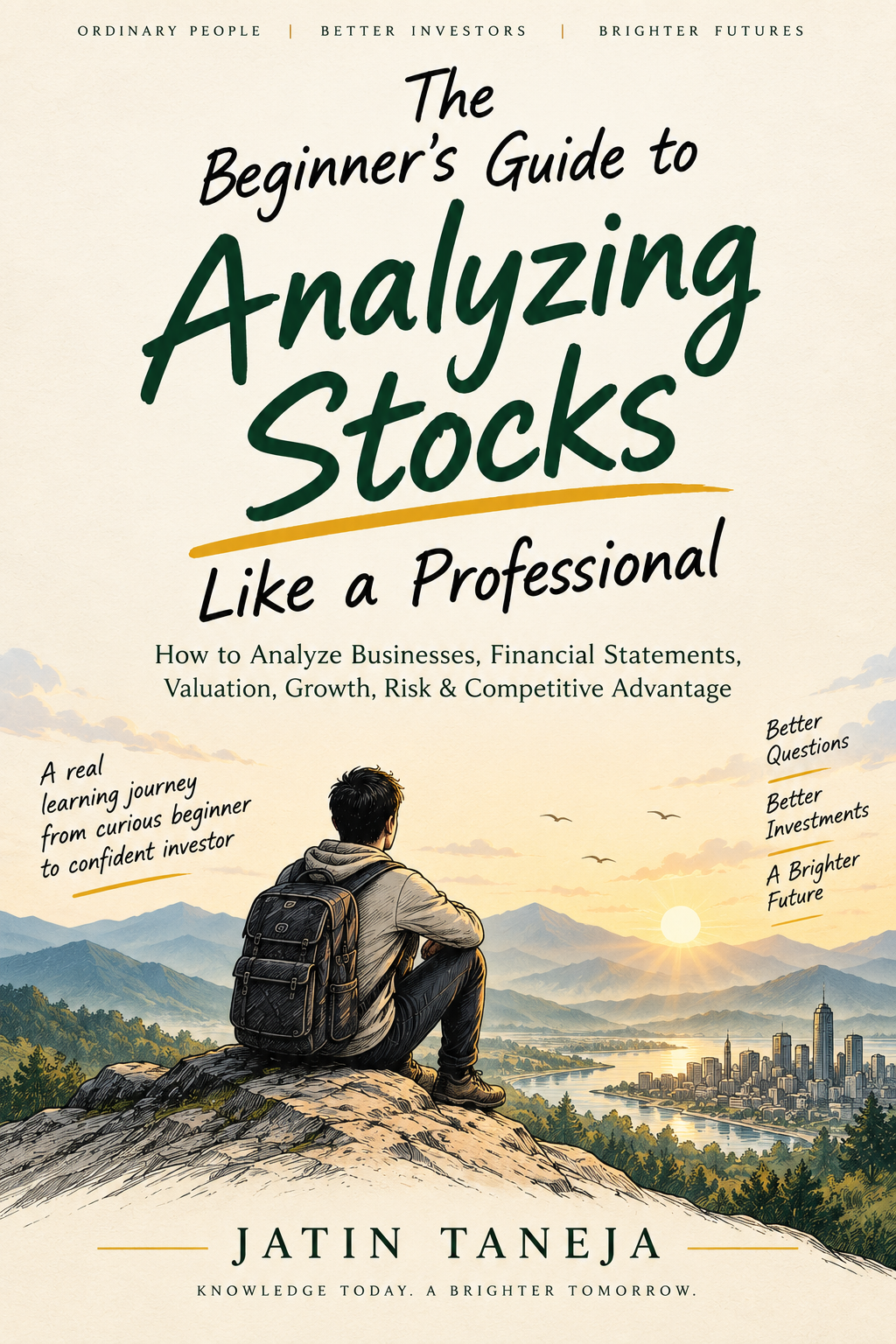
The Beginner's Guide to Analyzing Stocks Like a Professional teaches you a structured way to read a company — its business, financial statements, growth, competitive advantage, management, valuation and risk.
Learn how to look beyond the stock price and understand what you're actually buying. No degree required. 30 chapters, told through one beginner's journey.
Instant digital access after successful payment.
Buying a stock is easy. Understanding what you own is the hard part.
Most beginners enter the market through the front door of price. A chart is moving, a friend forwards a screenshot, a stock is “up 18%”. The temptation is to act first and understand later. It usually sounds like this:
You don't need to know everything. You need a framework.
From watching prices to reading businesses
- —“I look at the stock price.”
- —“I don't know how to read financial statements.”
- —“I don't know whether the company is actually good.”
- —“I don't know what makes a company difficult to compete with.”
- —“I don't know how to value a stock.”
- —“I don't know what to look for in an annual report.”
- —“I don't know how to build an investment thesis.”
- ✓“I know what the business actually does.”
- ✓“I can read the key financial statements.”
- ✓“I can evaluate profitability and returns on capital.”
- ✓“I can think about growth and competitive advantage.”
- ✓“I understand different valuation approaches.”
- ✓“I know what to look for in annual reports and earnings calls.”
- ✓“I can organize my research into an investment thesis.”
The book teaches a process for analyzing businesses. It does not promise investment profits, and it makes no claims about returns.
What you'll learn inside
Eight stages, in the order a professional would work through them. Price only shows up at number seven.
Understand the Business
Learn how to explain what a company actually does and how it makes money.
Understand the Industry
Learn how to think about competition, market structure and the environment a business operates in.
Read the Financials
Learn how to approach the income statement, balance sheet, cash flow statement and the ratios that matter.
Understand Growth
Learn where growth comes from, how to tell good growth from bad, and the economics of a compounder.
Find the Moat
Learn how to think about competitive advantages and whether a company's strengths survive competition.
Evaluate Management
Understand management decisions, capital allocation and how leaders deploy shareholder capital.
Value the Stock
Learn relative valuation, intrinsic value, a simple DCF, reverse DCF and margin of safety.
Handle Risk & Build a Thesis
Learn how to think about risk, difficult businesses, annual reports, earnings calls, and build an investment thesis.
Learn through a story — not a wall of definitions
The book follows Sam, a complete beginner. He buys his first stock on a Friday night after a friend forwards him a chart, watches it climb for three days, and then watches it fall twelve percent after results — without anything about the actual business having changed.
When his cousin Meera, who works at a research desk, asks him what he actually owns, he can't finish the sentence. That's where the learning starts.
“You bought a price. You didn't buy a business.”
Meera, five days later
From there you follow his questions and discoveries, chapter by chapter, in the same order a professional would ask them.
- 1Business
- 2Industry
- 3Financials
- 4Growth
- 5Moat
- 6Management
- 7Valuation
- 8Risk
- ◆Your investment thesis
Questions you'll learn to ask before you buy
Professional analysis is not one magic number. It's a case file built from better questions.
Written for the person starting at zero
Beginner-first, not finance-first
Concepts arrive when a problem needs them, not as a glossary you're expected to memorise.
Story-driven learning
Sam's questions carry the book. You learn alongside him instead of reading definitions in isolation.
Business before price
Valuation is the seventh step, not the first. A price means nothing until you know what it's a price of.
Practical financial statements
Six chapters on reading the numbers — including ratios, ROE, ROCE, ROIC and whether the numbers can be trusted.
Valuation, step by step
Relative valuation, intrinsic value, a simple DCF, reverse DCF and margin of safety, built up in sequence.
Difficult companies included
Cyclicals, turnarounds, expensive growth stocks, deep value and special situations get their own part.
A repeatable process
The eight questions work the same way on the next company, and the one after that.
Ends with a full test
The final chapter walks the whole framework end to end: analyze a stock from scratch.
Who is this book for?
- ✓Beginners entering the stock market
- ✓Investors who rely too heavily on stock prices
- ✓People who want to understand the businesses behind stocks
- ✓Readers intimidated by financial statements
- ✓Investors who want to learn valuation
- ✓People who want a structured stock-analysis process
- ✓Self-directed investors improving their research skills
Who this book is not for
- ✕People looking for guaranteed stock tips
- ✕People looking for guaranteed returns
- ✕People looking for intraday trading signals
- ✕People looking for buy/sell recommendations
This is an education product. It teaches a way of analyzing companies, nothing more and nothing less.
What's inside the book
30 Chapters • 8 Parts • 241-page edition
ISam Enters the Stock Market3 chapters
- Sam's First Stock
- Stop Looking at the Stock Price
- How Professionals Analyze a Stock
IILearn to See the Business4 chapters
- What Does This Company Actually Do?
- How Does It Make Money?
- Is This a Good Business?
- Does the Company Have a Moat?
IIILearn to Read the Numbers6 chapters
- The Income Statement
- The Balance Sheet
- The Cash Flow Statement
- The Most Important Financial Ratios
- ROE, ROCE and ROIC
- Can You Trust the Numbers?
IVLearn to Understand Growth4 chapters
- Where Does Growth Come From?
- Good Growth vs. Bad Growth
- The Economics of a Compounder
- Management and Capital Allocation
VValuing a Stock5 chapters
- Why a Great Company Can Be a Bad Investment
- Relative Valuation
- Intrinsic Value: The Big Idea
- Building a Simple DCF
- Reverse DCF and Margin of Safety
VILearn to Handle Difficult Companies4 chapters
- Understanding Risk
- Cyclical Businesses and Turnarounds
- High-Growth and Expensive Stocks
- Deep Value, Distressed Companies and Special Situations
VIILearn How Professional Research Actually Works3 chapters
- How to Read an Annual Report Like an Investor
- Earnings Calls and Management Commentary
- Build Your Investment Thesis
VIIIThe Final Test1 chapter
- Analyze a Stock From Scratch
Take a look inside
Three pages from the book: the chapter opener that starts Sam's story, the napkin that becomes the whole framework, and the distinction most beginners never get taught.
Sam's First Stock
“You bought a price. You didn't buy a business.”
— Meera, five days later
- 1The Business
What does it actually do, and how does it make money? - 2The Industry
How big is the playing field, and who else is on it? - 3The Financials
What do the numbers say, once you can read them? - 4Growth
Is it growing, and is that growth worth anything? - 5Competitive Advantage
What stops a rival from copying this and winning? - 6Management
Are the people running it spending your money wisely? - 7Valuation
What is a fair price for what you'd actually be buying? - 8Risk
What could go wrong here, and how badly would it hurt?
Fig. 1.2 Two different games that both use the same buy button.
What readers will love about the learning experience
“The financial statement chapters finally made the balance sheet feel readable instead of intimidating.”
“I used to check the price first. Now I start by asking what the company actually sells and to whom.”
“Following Sam made the concepts stick. It reads like a story, not a textbook.”
“Intrinsic value and DCF were always abstract to me. The step-by-step build made them much clearer.”
“Having eight questions to work through gives my research an order it never had before.”
“Annual reports used to feel unreadable. I now know which sections to open first and why.”
Start learning to analyze stocks today
Stop guessing what a stock price means. Start learning how to understand the business behind it.
The Beginner's Guide to Analyzing Stocks Like a Professional
30 chapters · 8 parts · 241-page edition · PDF
One-time payment.
GET THIS EBOOK — ₹199Instant digital access after successful payment.
- ✓All 30 chapters across 8 parts
- ✓The full eight-question analysis framework
- ✓Readable on phone, tablet and computer
Frequently asked
Is this book suitable for complete beginners?+
Yes. It's written for someone starting at zero. It opens with Sam buying his first stock without understanding what he bought, and builds every concept from there.
Do I need a finance or economics degree?+
No. As the preface puts it, you need curiosity, patience and a willingness to look beneath the price. Financial concepts are introduced through practical problems rather than isolated definitions.
Does the book provide stock recommendations?+
No. Companies and figures used in examples are illustrative and may be fictional or simplified. Nothing in the book should be treated as a recommendation to buy or sell any security.
Does the book guarantee investment returns?+
No. It is educational material. Investing involves risk, including loss of capital, and past performance does not guarantee future results.
Does it teach technical analysis or intraday trading?+
No. The book is about analyzing businesses — charts, signals and short-term trading are not what it teaches. Chapter 1 draws the line between investing and speculating early on.
What topics are covered?+
What a stock represents, investing vs speculation, market capitalisation and enterprise value, business models, industry analysis, the income statement, balance sheet and cash flow statement, financial ratios, ROE, ROCE and ROIC, the reliability of reported numbers, sources of growth, compounders, management and capital allocation, moats, relative valuation, intrinsic value, simple and reverse DCF, margin of safety, risk, cyclicals, turnarounds, expensive growth stocks, deep value and special situations, annual reports, earnings calls, and building an investment thesis.
How long is the book?+
30 chapters across 8 parts, in a 241-page edition.
How will I receive the ebook?+
After a successful payment you'll be redirected to a thank-you page where your download link is provided.
Is the ₹199 payment one-time?+
Yes. It's a single one-time payment for the digital edition. There is no subscription.
What happens after I complete payment?+
The payment gateway confirms your payment and redirects you to the thank-you page, where you can download the ebook straight away.
Can I read it on my phone or computer?+
Yes. It's a digital PDF edition and can be read on a phone, tablet or computer.
Who is the author?+
Jatin Taneja, who wrote and published the book independently. First edition, 2026.
Your next stock analysis can start with better questions.
Learn to understand the business, read the financial statements, judge growth and competitive advantage, weigh management's decisions, value the stock and think clearly about risk — then put it together into one thesis you can explain.
Instant digital access after successful payment.
This book is for educational and informational purposes only. It is not investment, financial, tax, accounting or legal advice. Stock market investing involves risk, including loss of capital, and past performance does not guarantee future results.
Read full disclaimer
Examples, calculations, companies, scenarios and valuation illustrations in the book explain concepts and should not be treated as recommendations to buy or sell any security. Financial information can change; real-world analysis requires current filings, disclosures, prices, industry conditions and independent verification. Conduct your own research and, where appropriate, consult a qualified financial professional. The author does not guarantee the accuracy, completeness or timeliness of any information presented and is not responsible for investment decisions made using the material in the book.